

Digital Infrastructure Programme
Our digital infrastructure programme is delivering improved digital connectivity across the sub-region.
Contrary to perception, hundreds of thousands of addresses in London are affected by slow digital connectivity, causing digital inequalities that impede the lives of people and businesses.
Around 86,000 premises in our sub-region do not have access to high speed – Gigabit capable – internet connections, based on the latest Ofcom Connected Nations research. This figue was higher. We are continuing to work with the private sector and our boroughs to reduce the number of premises affected and improve digital connectivity across our sub-region.
86,000
premises have slow or no connectivity in our sub-region
£20m
we have secured £20m investment but need more to improve connectivity

How we are improving digital connectivity in our sub-region
Our programme is stimulating investment and is making our boroughs more attractive for both the telecommunications industry and the subsequent leverage of inward investment by highly skilled digital intensive industries. This is:
- Increasing local productivity and employment.
- Reducing gaps in access to digital services across the region through increased availability and lowered cost of ownership – accompanied by a focus on skills and demand stimulation.
- Enhancing ability to deliver local services, notably education, health, community safety and transport.
- Creating environmental benefits.
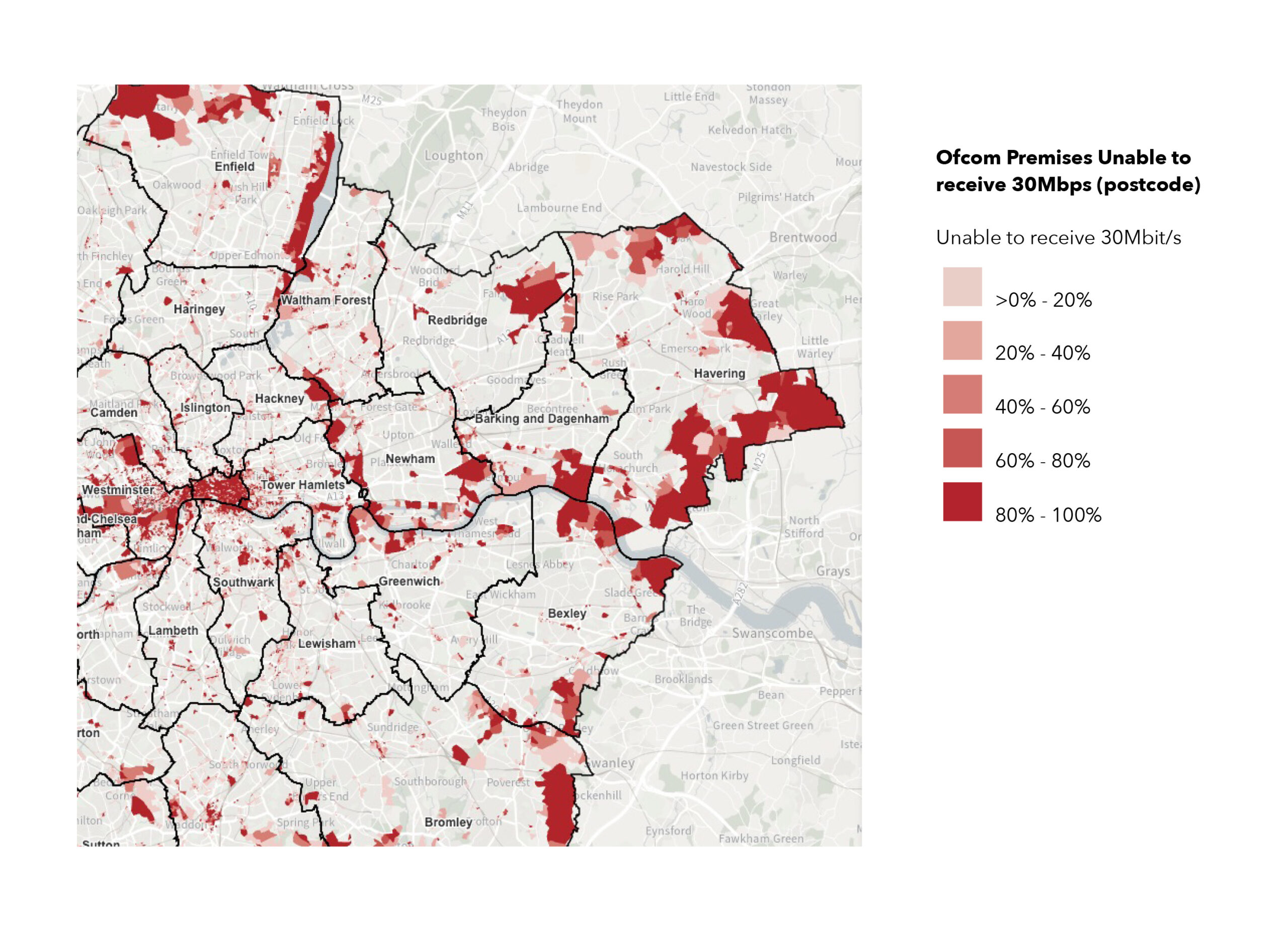
Map showing low and no connectivity areas across Local London

What we are doing
- Funding and procuring full fibre infrastructure to public sites across the region.
- Proactively engaging with the telecommunications industry to stimulate investment and remove barriers.
- Establishing wayleave agreements to stimulate fibre connectivity in social housing.
- Establishing clear organisation structures to ensure dialogue between the public sector and the telecommunications industry is enhanced and digital infrastructure is at the heart of the regions programmes.
Our investment opportunity
While we have secured around £20m investment into our boroughs to improve digital connectivity, our research highlights barriers preventing us from achieving ubiquitous world-class connectivity befitting of expectation of being part of London.
As a result, we need additional funding to:
- Expand dark fibre spines – notably to growth areas but also key areas of regeneration.
- Enhance service provision to public sector sites and assets.
- Anchor inward investment.
- Deliver local business and residential support to drive adoption (awareness, stimulation and possible connection subsidy.)
- Facilitate enhanced mobile coverage and capacity (eg neutral hosts, use of assets.)
Find out more in our 'Delivering Economic Growth in Local London: Digital Connectivity Requirements' paper.
Our Digital Infrastructure Strategy
Contrary to perception, there remain parts of London that have suffered from a lack of commercial investment in digital infrastructure that consequently has resulted in underlying gaps in delivery capability. These gaps need to be closed in order for boroughs within the Local London and the South London Partnership sub-regions to achieve their growth goals.
Experience across London, and indeed across the UK as a whole, has shown that local authorities that are the most proactive benefit from the greatest level of inward investment.

Connected London
Digital connectivity is essential for Londoners to access the services they need in an increasingly digital world. Small and medium-sized enterprises (SMEs) that have access to affordable gigabit-capable connections can experience productivity increases of 7-10%. Additionally, properties without access to higher broadband speeds can see a reduction in value by 20%. The number of connected devices is growing rapidly, and it is estimated to increase 12-fold by 2026.
The Connected London team works with local authorities and digital infrastructure providers to coordinate investments in underserved areas. They collaborate with Transport for London (TfL) to establish a full fibre network using TfL assets, such as underground tunnels and street furniture. They also facilitate regional working groups to address coordination challenges and share knowledge. The team engages with providers to understand their priorities and issues, aiming to improve connectivity across the city. They have also developed and implemented strong digital connectivity planning policies through the London Plan.
Driving user awareness and digital inclusion
LOTI
LOTI (London Office of Technology and Innovation) helps London borough councils and the Greater London Authority work together to bring the best of technology, data and innovation to improve public services and outcomes for Londoners.
For more information on how LOTI can support your borough or to become a member visit the Loti website.
Good Things Foundation
The Good Things Foundation has a vision for a world where everyone benefits from digital. The Foundation wants people to be digitally able, equal and safe, so they can be happier, healthier and better off.